“Three weeks in, the spreadsheet stopped disagreeing with the interviews. The men weren’t shopping. They were reading.”
From the margin memo, week 3
The problem.
Men over 40 quietly Google their foot problems. Clinical sites scare them. Commerce sites push to them. The articles that ranked were written for women, repackaged with a stock photo of a guy.
Week 1
Margin modeling
Sourced sample lots from six manufacturers. Modeled margins across three price tiers. Every product path leaked to competitors with better selection.
Week 2
Customer interviews
Eight conversations with men 35 to 55 who had bought dress shoes in the last year. Almost all had a foot pain story. None had shopped for shoes with a diagnostic question in mind.
Week 3
The pivot
Traffic and search data pointed at information, not products. Recategorized the site around foot conditions before the catalog was ever built.
Three weeks of margin modeling, one pivot
The Original Plan
E-commerce
Shopify storefront
Product reviews
Cart / checkout
Subscription tier
Newsletter popup
Week 3
Margin modeling kept pointing at information, not products.
What Shipped
Editorial
Long-form pillars
Assessment branch
Affiliate context
Routine prompts
No popups
The bet.
Build a male-specific foot-health resource at the intersection of clinical, wellness, and product-first. The first plan was e-commerce. Three weeks into margin modeling, the research kept pointing at the same thing: information, not products. I pivoted to content authority and used e-commerce UX patterns to frame editorial decisions.
Men’s Sole Revival
“After years of neglect, men over 40 finally have a place to start.”
Editorial Inkvar(--color-text)
Cognac#C4703A
Deep Cognac#A35E32
Paper#F5F0E8
A brand that’s actually for men.
Most men’s wellness brands aren’t for men. They’re rebranded women’s content with a stock photo of a guy. MSR starts from how men actually search for foot problems: quietly, with shame, after years of neglect. The brand voice is direct and clinical, never cold. Barlow Condensed for editorial heat, Lora for long-form trust, cognac as a grounded accent against editorial near-black.
Built once. Used everywhere.
Token-led from the start. Color, type, spacing as primitives. Article pattern, assessment branch, review card, routine prompt all read from the same vocabulary. Thirteen components carry every page on the site. Documented in Figma so the next designer who picks this up doesn’t have to rebuild the rules.
→ Three panels: color tokens, type ramp, components.
→ Three panels, stacking as you scroll.
01Color tokens
Six tokens. Every color on every page resolves through one of these. Cognac is the only saturated tone; everything else is a paper-to-ink scale.
Editorial Ink
var(--color-text)
Display + body ink
Cognac
#C4703A
Brand + key actions
Deep Cognac
#A35E32
Hover + emphasis
Paper
#F5F0E8
Surface
Stone
#A99B8A
Borders + secondary
Pulse Red
#C8341A
Severity high
02Type ramp
Two faces, no third. Barlow Condensed carries every display and section label. Lora carries every long-form paragraph and italic callout.
Long-form reading sits in Lora. Italic for citations and callouts.
“After years of neglect, men over 40 finally have a place to start.”
400, 500, 600, 700 weights · roman + italic
03Components
Thirteen components carry every page. Each one is documented in the Figma source with use rules, anatomy, and the data shape it expects.
01
Article hero
Eyebrow · title · meta · cover
02
Pull quote
Italic Lora + cognac rule
03
On-page nav
Sticky section TOC, mobile drawer
04
Symptom card
Check-list + count threshold
05
Severity gate
Tier callout (low / mid / clinic)
06
Triage option
Select-all-that-apply chip
07
Routine prompt
Action · cadence · duration
08
Review card
Product · verdict · disclosure
09
Affiliate CTA
Disclosure-first link button
10
Editorial figure
Inline image + caption + credit
11
Footnote rail
Citation list + cross-links
12
Author byline
Photo · role · update date
13
Site footer
Nav · sources · accessibility
Shipped.
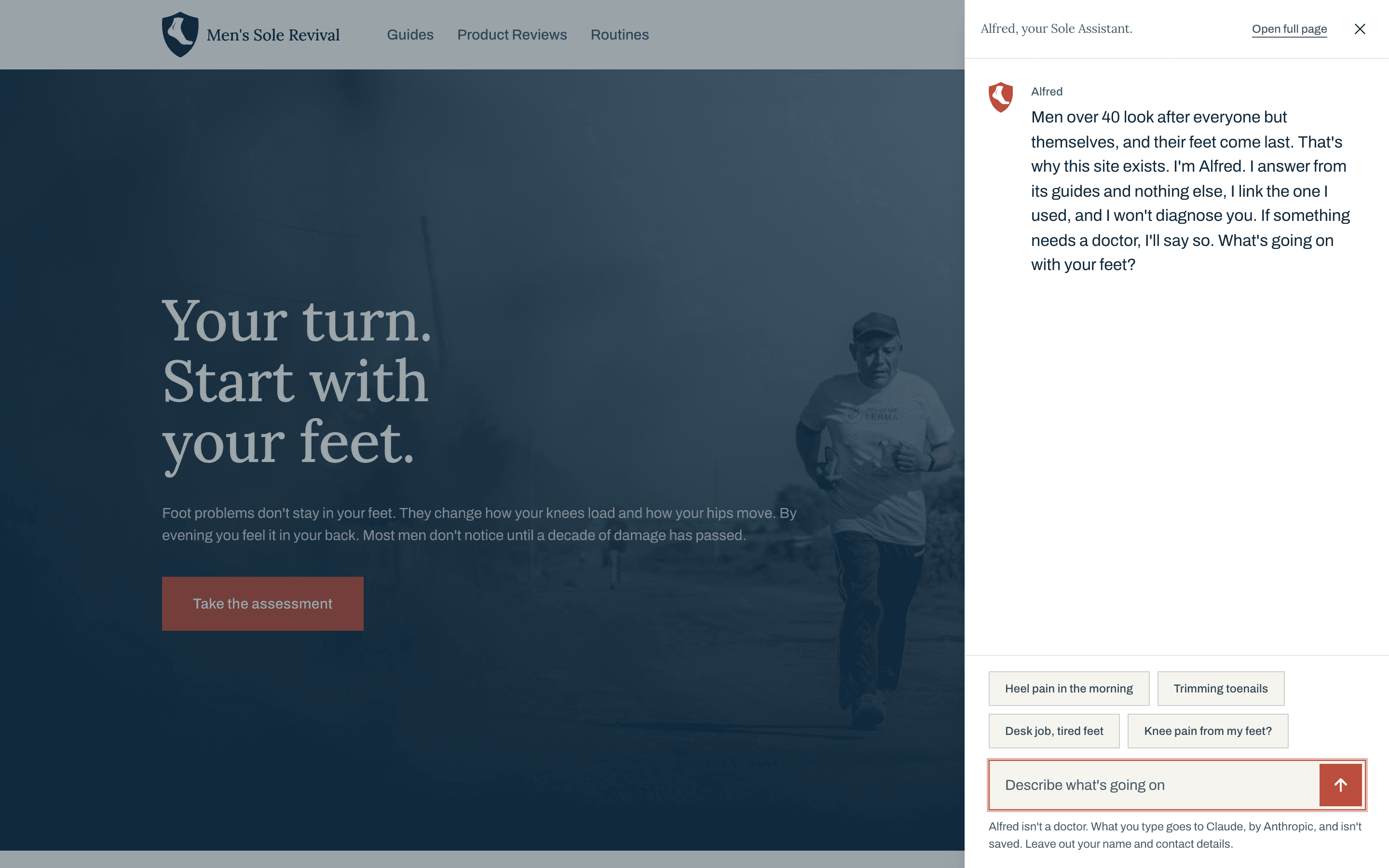
menssolerevival.com, live since April 2026. Long-form pillar articles, a five-section assessment that branches by symptom, product reviews structured for trust, and an editorial system documented in 13 components. The site exists where the three categories overlap, not as a compromise between them.
Triage: select-all-that-apply across five symptom areas. Routes you only to the sections that apply.
Section: symptom checklist with prevalence stat + peer-reviewed source. Threshold copy explains what the count means.
Sticky section nav lists only the sections the user triaged. The Skip This Section button never disappears.
02
Stat, then source. Never the reverse.
8.57% prevalence with a peer-reviewed citation directly under it. Journal, author, year. Trust before recommendation.
03
Humane checklist language.
“Nails are thick, yellowed, white, or brittle” instead of clinical terms. Written the way a man actually describes what he sees.
04
Every section closes with a 3-beat block.
“3+ checks likely points to fungal infection or an ingrown nail. Both are treatable. The guide at the end points you in the right direction.” What the count means · reassurance · next step. The user never gets left with a raw number.
Early outcomes · first 16 weeks live · GA4, Apr–Jul 2026
4:30
Average engagement time per user. High for a content site, and the exact signal MSR was built to produce.
3.2
Sessions per user across 53 users in 7 countries with zero paid promotion. Early readers come back.
Interaction
The routing logic is the whole case.
The same three-step routing that runs behind the assessment on the live site. Pick what’s bothering you, then follow it through select, route, and hand-off.
Live · Diagnostic routing
Where's the trouble? (Pick one or more.)
Select at least one to continue.
Trade-offs
The mobile read is the dominant one. Pillar articles, assessment, and reviews all designed mobile-first.